
Serenoa repens
saw palmetto
Arecaceae (Palmae)
Plant Specifics
Form:
Size:
Life Span:
long-lived perennial
Flower Color:
Fruit Color:
Phenology:
Noted For:
Landscaping
Recommended Uses:
Considerations:
Be sure to plan for enough room for this spreading plant.
Light:
Moisture Tolerance:
Usually moist, occasional inundation ---- to ---- Very long very dry periods
Salt Water Flooding Tolerance:
Unknown
Salt Spray/Salty Soil Tolerance:
Moderate. Tolerant of salty wind and may get some salt spray.
Soil or Other Substrate:
Sand, Loam
Suitable to Grow In:
8A,8B,9A,9B,10A,10B,11
Ecology
Wildlife:
Larval host plant for monk skipper ( Asbolis capucinus ) and palmetto skipper ( Euphyes arpa ) butterflies.
Nectar plant for Bartram's scrub-hairstreak (S trymon acis ), atala ( Eumaes atala) and other butterflies.
Documented bees visiting the plant include Colletes banksi, C. brimleyi, C. mandibularis, C. rzudus, Colletes sp. A, Hylaeus graenicheri, Agaposternon splendens, Augochlora pura, Augochlorella aurata, Augochloropsis metallica, A. sumptuosa, Dialictus miniatulus, D. nymphalis, D. placidensis, D. tegularis, Evylaeus pectoralis, Halictus ligatus, Sphecodes heraclei, Coelioxys sayi, Dianthidium. floridiense, Megachile policaris, M. xylocopoides, Epeolus erigeronis, E. glabratus, E. zonatus, Apis mellifera, Bombus impatiens, B. pennsylvanicus , and Xylocopa virginica krombeini (Deyrup et al. 2002). Another study documented 311 species of flower visitors including 121 species of bees, 117 species of flies, and 52 species of beetles (Deyrup and Deyrup 2012).
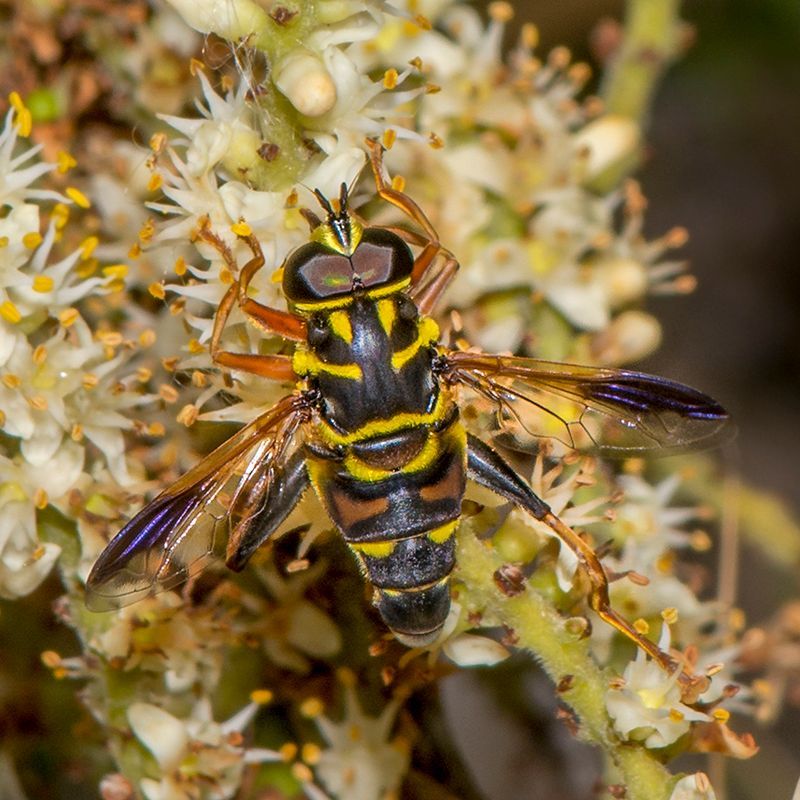
Saw palmetto also attracts Syrphid flies including the flower fly, Meromacrus acutus , which apparently is a saw palmetto specialist (John Lampkin, 2019)
Palmetto berries are important bear food.
More than 100 bird species, 27 mammals, 25 amphibians, 61 reptiles, and countless insects use it as food and/or cover (Maehr and Layne 1996).
As Maehr and Layne summarize, “ If saw palmetto is not the plant species most highly used by Florida wildlife, it certainly is in close contention for that honor.”
Native Habitats:

