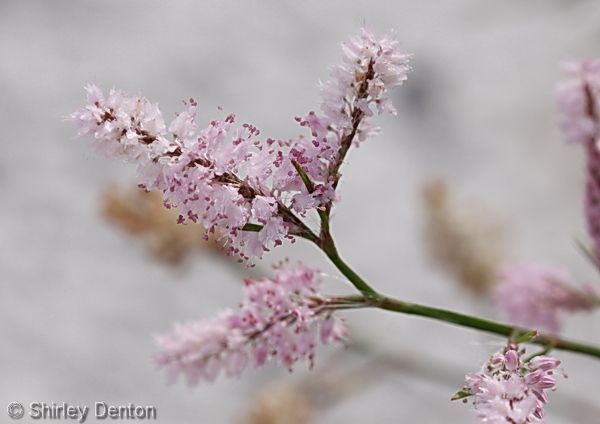
Polygonum nesomii
largeflower jointweed, sandhill wireweed
Polygonaceae
Plant Specifics
Form:
Size:
Life Span:
short-lived perennial
Flower Color:
Fruit Color:
Phenology:
Noted For:
Landscaping
Recommended Uses:
Considerations:
Light:
Moisture Tolerance:
Not wet but not extremely dry ---- to ---- Very long very dry periods
Salt Water Flooding Tolerance:
Unknown
Salt Spray/Salty Soil Tolerance:
Low/no tolerance of salty wind or direct salt spray
Soil or Other Substrate:
Sand
Suitable to Grow In:
Ecology
Wildlife:
Attracts bees and butterflies ( Hawthorn Hill ). Documented bee visitors include Colletes mandibularis, C. thysanellae, Colletes sp. A, Hylaeus confluens, Augochlora pura, Augochlorella aurata, Augochloropsis anonyina, A. szcmnptuosa, Dialictus ininiatulus, D. nymnphalis, D. placidensis, Sphecodes heraclei, Anthidiellum perplexurn, Coelioxys sayi, C. octodentata, Megachile albitarsis, Apis inellifera and Bornbus impatiens (Deyrup et al. 2002).
Seeds eaten by birds.
Native Habitats:

