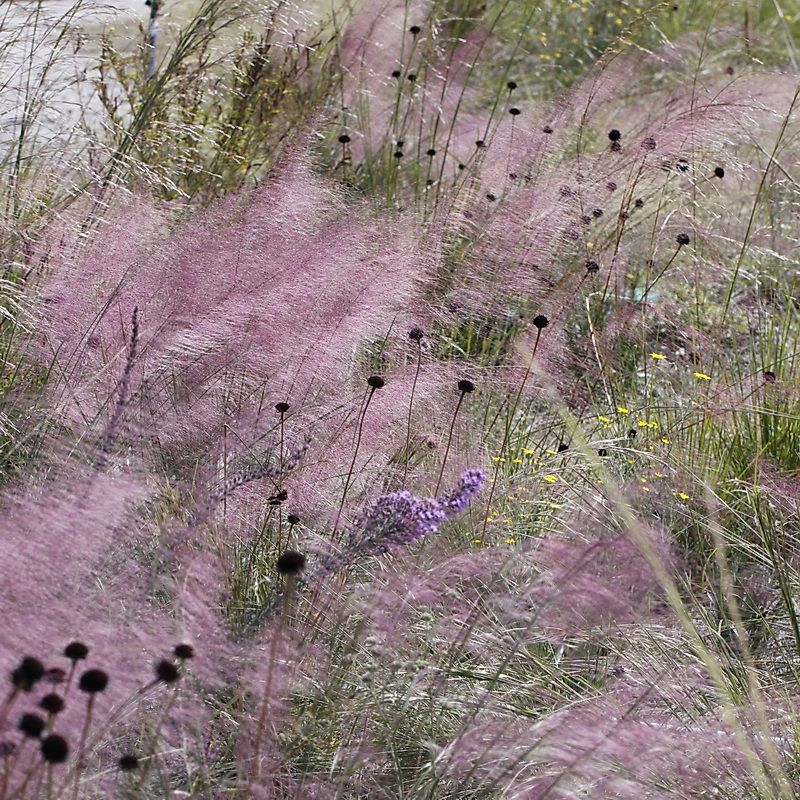
• Photo by: Shirley Denton, Suncoast Chapter FNPS
  • Photo by: Archbold Bioloical Station
  • Photo by: Ginny Stibolt, Ixia Chapter FNPS
  • Photo by: Eleanor Dietrich, Magnolia Chapter FNPS
  • Photo by: Shirley Denton, Suncoast Chapter FNPS

Muhlenbergia capillaris

hairgrass, muhly grass

Nomenclature

Common Name:

hairgrass, muhly grass

Synonym(s):

Genus species:

Muhlenbergia capillaris

Family:

Poaceae (Gramineae)

Plant Specifics

Form:

grass

Size:

2 to 3 (4) ft tall by 1.0 to 3.5 ft wide

Life Span:

Long-lived perennial

Flower Color:

pink/purple

Fruit Color:

pink/purple

Phenology:

Evergreen. Forms dense clumps. Blooms in mid- fall.

Noted For:

Showy Flowers, Showy Fruits, Interesting Foliage

Landscaping

Recommended Uses:

Hedge, specimen plant, mass planting

Considerations:

Text

Availability:

Text

Propagation:

Text

Light:

Text

Moisture Tolerance:

Always Flooded---------------------------------Extremely Dry

â–¡â–¡â–¡â–¡â–¡â–¡â–¡â–¡â–¡â–¡â–¡â–¡â–¡â–¡â–¡â– â– â– â– â– â– â– â– â– â– â– â– â– â– â– â– â– â– â– â– â– â– â– â– â–¡â–¡â–¡

Usually moist, occasional inundation -to- Very long very dry periods

Salt Water Flooding Tolerance:

Unknown

Salt Spray/Salty Soil Tolerance:

Moderate. Tolerant of salty wind and may get some salt spray.

Soil or Other Substrate:

Sand, Clay, Lime Rock

Soil pH:

Adaptable

Suitable to Grow In:

8A,8B,9A,9B,10A,10B,11

Ecology

Wildlife:

Birds

Muhly grass forms a low canopy that small animals can use for shelter and refuge.


Small birds eat the seeds.

Native Habitats:

Flatwoods, marshes, scrub.

Comments:

Ethnobotany:

Also known as sweetgrass, which has been used for coiled basketry, particularly in the "low country" of South Carolina, Georgia, and northeast Florida, by people of the Gullah Culture.

General Comments:

There are three subspecies included in this description.  Together, they are found in all coastal counties of Florida and many inland ones.  As a grass, it is likely undercollected and it has likely been excluded by many agricultural practices, so at least one of these subspecies is potentially native throughout Florida.  Muhlenbergia capillaris var. capillaris is the subspecies that is most commonly available from nurseries.