

Gaylussacia dumosa
dwarf huckleberry
Ericaceae
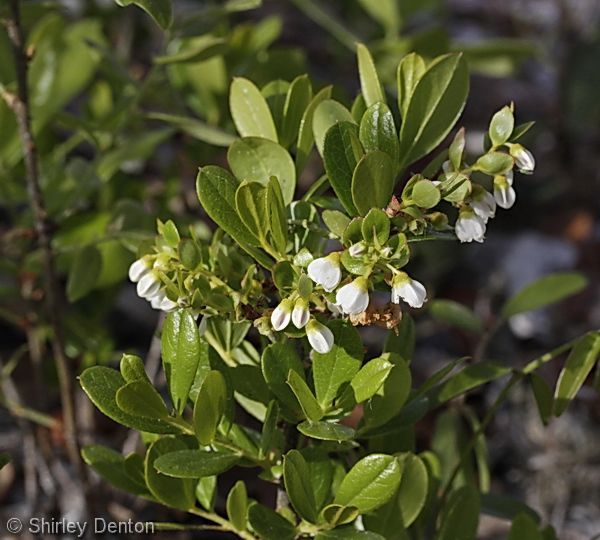
Plant Specifics
Form:
shrub
Size:
1-2 ft tall, similar in width, but spreads by rhizomes to form large colonies.
Life Span:
long-lived perennial
Flower Color:
white
Fruit Color:
black
Phenology:
deciduous
Noted For:
Showy Flowers, Fall Color
Landscaping
Recommended Uses:
Groundcover for dry sites. Clonal (forms small clumps of stems).It has deep red foliage in fall.
Considerations:
Slow growing and difficult to establish.
Light:
Full Sun, Part Sun
Moisture Tolerance:
Somewhat moist, no flooding ---- to ---- Very long very dry periods
Salt Water Flooding Tolerance:
Unknown
Salt Spray/Salty Soil Tolerance:
Low/no tolerance of salty wind or direct salt spray
Soil or Other Substrate:
Sand
Suitable to Grow In:
8A,8B,9A,9B
Ecology
Wildlife:
Pollinators, Birds, Mammals
Attracts native bees includeing Augochlorella aurata, A. gratiosa, Megachile breuis pseudobrevis, M. integrella plus the non-native Apis mellifera (honeybee) and Bombus irnpatiens (Deyrup et al. 2002).
Birds and small mammals eat the fruit.
Native Habitats:
Sandhills, flatwoods, flatwoods, flatwoods-wetland transition zones, hydric seep slopes including cutthroat seeps and edges of shrub-tree bogs, scrubby flatwoods, scrub.

